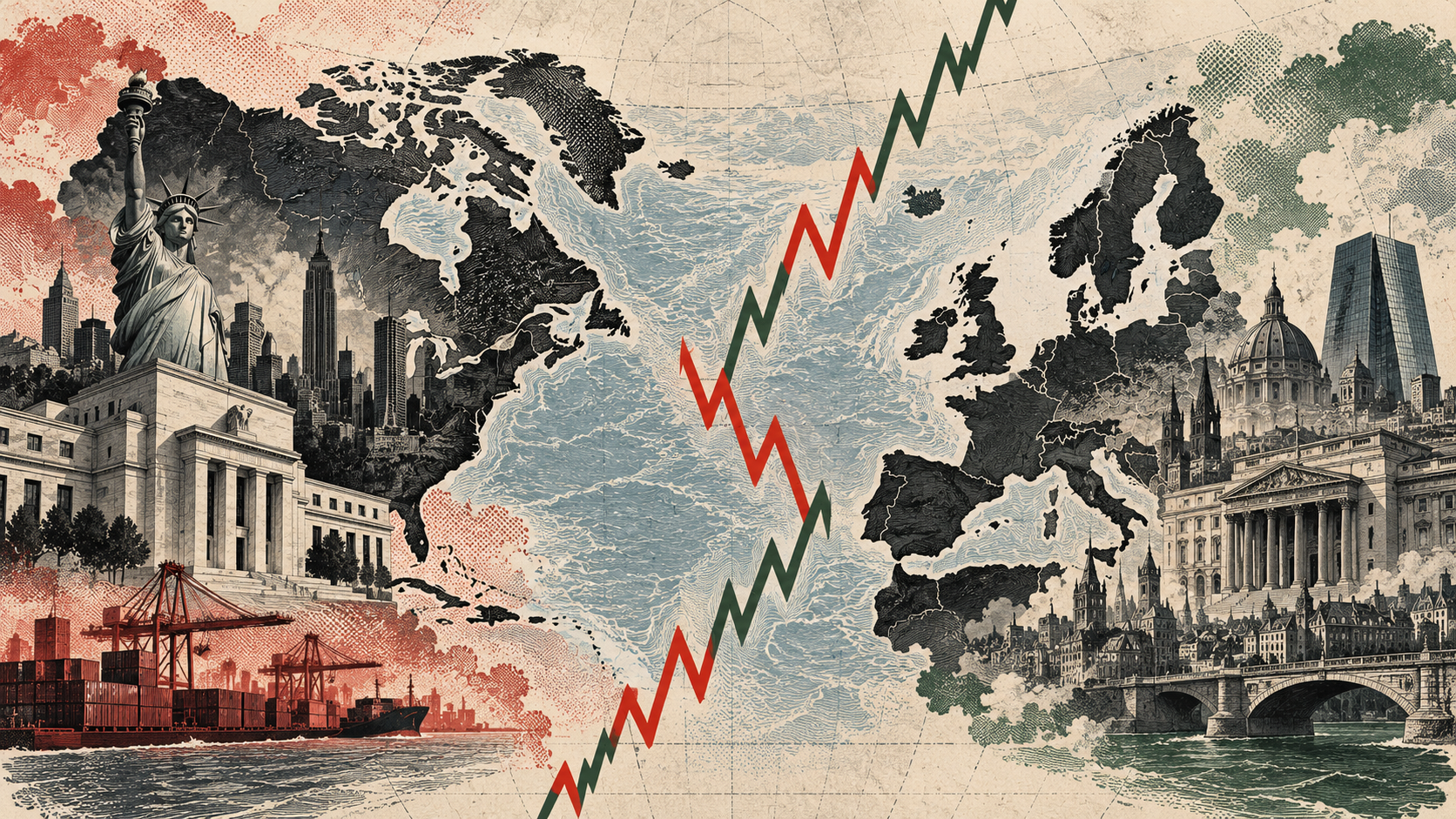
If inflation starts with more expensive energy, why make money more expensive too? What central banks can achieve, and who bears the cost.
If the problem is more expensive energy, making money more expensive too strikes me as a response to question, rather than a solution to take for granted. Interest rates can restrain the spread of price increases. But they do not, by themselves, make more oil, gas or electricity available.
The same shopping basket, more money.
Inflation is an increase in the general price level of goods and services. It is measured by tracking the cost of a representative basket over time. If that basket costs more and my income does not keep pace, the same money buys less.
Take a purely illustrative example: a basket costing €100 in January and €102 in February has risen by 2% compared with the previous month. That is the monthly change. Comparing February with February a year earlier gives the annual change, which is what the inflation views in the chart show.
We do not all experience the same increase: people who spend more of their income on heating or fuel may feel the rise more sharply. And slower inflation does not automatically reverse price increases. If the basket goes from €100 to €110 and then rises another 2%, it reaches €112.20: prices are growing more slowly, but remain higher.
2021–2022: rising prices, money still relatively cheap.
This is the sequence I want to understand. In 2021, economies were reopening after pandemic restrictions: demand was recovering while production and transport faced difficulties. Energy prices added to supply bottlenecks. The ECB’s account describes a combination of demand and supply factors, subsequently compounded by the energy crisis and Russia’s invasion of Ukraine.
Meanwhile, policy rates were still very low. This supported more accessible financing conditions than a restrictive policy would. It did not mean money automatically circulated, or reached everyone equally: actual lending, household spending and investment are different quantities, which these charts do not measure.
But 2022 did not stay the same from start to finish. On 16 March, the Fed announced an increase in its target range to 0.25–0.50%. On 21 July, the ECB announced a 0.50 percentage-point increase, taking the deposit rate from −0.50% to zero effective 27 July. That is why looking at individual months matters, rather than only annual averages.
Energy also feeds into prices outside the energy category.
Oil and gas are not just about filling a tank or paying a utility bill. Producing and transporting goods takes energy: some increases can therefore reach final prices through businesses’ costs. PPI helps track prices upstream, but does not capture every cost or mechanically predict CPI.
An important distinction: a 20% rise in the energy component does not mean energy adds 20 percentage points to overall inflation. Its basket weight and the pass-through of costs matter. The charts do not establish that energy accounts for all, or most, inflation; they provide evidence against which to test that explanation.
So why raise interest rates?
Central banks’ response has a rationale: preventing an initial shock from turning into persistent, widespread price increases. More expensive credit can restrain purchases and investment, reducing demand and the scope for passing further increases on to customers. The duration of the shock and expectations about prices are crucial to the response, as the Bank for International Settlements explains.
That is the potential benefit. The cost is that slowing demand affects real decisions: buying a home, starting a business or financing equipment. Variable-rate mortgage borrowers may face increases depending on their contracts; an existing fixed-rate mortgage does not automatically become more expensive. Policy rates are also different from the rates banks charge customers.
My view: making spending harder is not enough.
In my view, the limitation becomes clear when we ask monetary tightening to solve energy vulnerability as well. We can restrain spending while remaining dependent on supplies exposed to the same risks. More expensive credit can also make the investments needed to reduce that dependence less attractive.
Higher interest rates can restrain the spread of a price shock. Becoming less vulnerable to the next one also means changing the conditions that make it so damaging.
I do not conclude that interest rates should always remain low. I conclude that every increase should be assessed alongside its costs: how much it restrains price pressures, who it affects most and which investments it risks delaying. These curves alone cannot establish whether a particular decision was excessive, or how much of the slowdown in inflation was caused by interest rates.
Resilience also means reducing dependence.
The approach I favour combines monetary policy with measures addressing vulnerability: diversifying supplies, improving efficiency, investing in production, grids and storage, and targeting support at those least able to absorb higher prices. Diversification, energy savings and renewable energy are also pillars of Europe’s REPowerEU plan. Assessing its results and comparing them with US policies requires a further investigation.
For me, this is the test: an effective response should help us get through today’s shock and suffer less from tomorrow’s. If we only make money more expensive, we risk asking households to spend less without building enough alternatives.
Reading the data: CPI and HICP measure different baskets. The Fed’s target concerns PCE over the longer run; the ECB’s concerns HICP over the medium term. The dedicated view distinguishes these from other measures. Sources, dates and comparison limits are available below the chart.